
.png?width=96&height=96&name=image%20(5).png)

In this article
Key points
- Beyond valuation, companies need predictable growth, a compelling equity story, public-grade infrastructure, and the right market timing to be IPO-ready.
- Companies might delay an IPO during both market slumps and market booms due to valuation concerns.
- The private secondary market gives companies a vital release valve to provide liquidity and manage their cap tables without rushing a public listing.
The IPO market has been active in recent months, marked by blockbusters like SpaceX and Cerebras. But behind the hype lies a clear paradox: even in an era of mega-deals, plenty of heavily valued late-stage startups are choosing to stay on the sidelines.
This discrepancy raises the important question: what does make a company IPO-ready in today’s market?
It turns out that having a massive valuation, while helpful, is no longer enough. Making the leap to the public market requires strength beyond scale—including predictable growth quality, an enticing equity story for investors, and public-grade infrastructure (read our full IPO playbook here). And perhaps most importantly, it takes the right market conditions to earn investor trust—which is one of the reasons why the private secondary market has become such a game-changer.
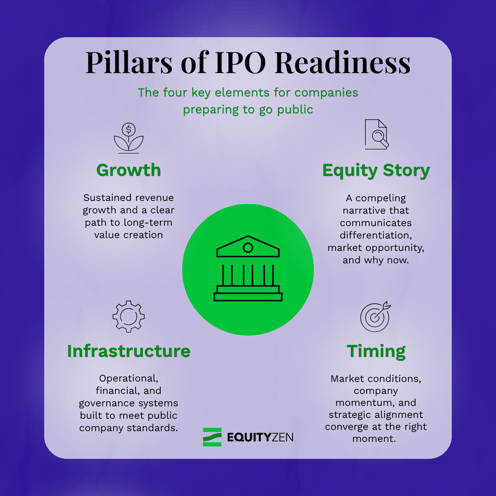
Growth
The venture capital market is no stranger to hypergrowth, high-risk bets. Because venture-backed startups lack hard assets and often generate negative operating cash flow, they rarely qualify for corporate loans. That leaves venture equity as their primary engine for capital.
The public markets, on the other hand, operate with a completely different mindset. Here, investors consistently prefer predictability over possibility. Because public companies are required to report earnings quarterly, and because public investors may liquidate at any time, the market can be highly volatile. If a listed company misses its quarterly earnings, public investors don’t have to wait around—and stock prices could plummet literally overnight.
Against this backdrop, companies need to thoroughly demonstrate their quality of growth before being able to consider an IPO. But top-line expansion over time is not the only factor. Other key metrics that come under the microscope for a pre-IPO company include:
- Annual (or Monthly) Recurring Revenue (ARR/MRR): The predictable, highly repeatable income a company expects to generate every year (or month) through subscriptions or ongoing contracts, serving as a baseline for future sales.
- Customer Acquisition Cost (CAC): The total sales and marketing spend required to win a single new customer, which measures go-to-market efficiency.
- Customer Lifetime Value (LTV): The total estimated profit a single customer generates throughout their entire relationship with the business.
- Gross Margin: The percentage of revenue left over after subtracting the direct costs of producing the product or service, showing how efficiently a company turns sales into profit to fund operations.
- Churn Rate: The percentage of customers (or revenue) that cancels or stops using the service over a given timeframe, which highlights customer retention and product satisfaction.
- Diversified Revenue Streams: Income generated from having multiple products, services, or pricing channels, ensuring the business isn’t overly dependent on a single offering.
- Diversified Customer Base: A well-balanced mix of clients across different industries and sizes, proving the company isn’t vulnerable if its largest account leaves.
Taken together, these metrics help illustrate whether a company possesses predictability, capital efficiency, strong retention, and healthy cash conversion—the ingredients of sustainable growth.
Equity story
Going public introduces a company to an entirely different investor base. While historical metrics prove past performance, a strong equity story goes a step further by looking forward—defining a company’s total market opportunity and vision for the future.
A strong equity story typically answers five questions:
1) Market size: How large is the addressable market, and is it growing? If so, why?
2) Defensibility: What are the competitive advantages that make a business difficult to replicate or replace?
3) Revenue sources: Where will future revenue growth come from over the next 3-5 years?
4) Unit economics: Can growth translate into sustainable profits and cash flow?
5) Long-term growth: What could this company become over the next decade?
Beyond addressing these points, a compelling equity story also helps investors connect with the people behind the company—bringing the business to life through founder stories, customer case studies, and testimonials. Combining hard fundamentals with a human-centric approach turns a routine pitch into a much stronger case for IPO readiness.
Infrastructure
IPO readiness goes deeper than headline financial performance and a compelling investor narrative. Late-stage startups preparing for an IPO also need to demonstrate that their underlying infrastructure can withstand the scrutiny of a public company.
Public companies, which have much more demanding reporting obligations, need to be capable of producing audited financial statements, reliable quarterly closes, scalable accounting systems, and accurate forecasting—all of which require rigorous, tested processes. On top of that, they must have strong data governance, cybersecurity, and IT controls to help safeguard the integrity of their reporting and earn investor trust. Because buildouts of this scale take time, PwC recommends that prospective issuers operate as though they are already public for at least 12 months before the desired IPO date.1
Governance maturity is just as important. Installing leadership with previous public company experience and independent directors early facilitates a smooth transition to public life. PwC benchmarking underscores the importance of executive hiring before an IPO—with 75% of tech CFOs having prior public-company experience, according to an August 2025 report. 2
Timing
Even a company with seemingly flawless financials, strong growth prospects, a powerful equity story, and a rock-solid infrastructure can’t go public in a vacuum. Successful IPOs also depend on a variable that lies completely outside of a company’s control: timing.
Favorable market conditions (often called the “IPO window”) are critical for maximizing valuation. Because underwriters price an IPO largely based on peer public companies, listing during a market slump can force a steep discount or result in a down-round IPO, where the public valuation dips below prior funding rounds. This triggers dilution, or the reduction of existing shareholders’ ownership percentages. Dilution happens because, when a company’s valuation drops, it must issue more new shares to raise the capital it needs. As the total pool of shares expands, existing shareholders end up owning a smaller slice of the overall pie–a scenario that can damage investor confidence.
Listing during a market boom can also backfire by creating unrealistic expectations and post-listing valuation drops. For example, Anduril CEO Brian Schimpf recently said that the defense tech company would avoid a near-term IPO out of concern that the market was “in the middle of a hype cycle.”3 “We define a successful IPO as our investors got a good return three years from actually going out,” Schimpf explained, underscoring the complexity of IPO timing decisions.4
The role of secondary liquidity programs
Given all these considerations, being “IPO-ready” doesn’t necessarily mean “IPO-now.” But at the same time, as companies stay private longer, employees and early investors may accumulate substantial equity positions and seek pre-IPO liquidity.
That’s where secondary liquidity programs come in. Platforms like EquityZen provide a space for pre-IPO trading without forcing a premature public debut. They also expand access for investors looking to tap into the private market’s growing array of investment opportunities. As such, the private secondary market, while not without risk, has become a vital release valve. One projection estimates $250 billion in volume by the end of 2026 alone.5
Ultimately, secondary liquidity programs allow companies to extend their private lifecycles, while offering early investors, founders, and employees a reliable mechanism to realize returns—a combination that can, in fact, help companies prepare more successfully for an eventual IPO.
Putting it all together
Companies in today’s market need to prove their IPO readiness on several fronts simultaneously: financially, strategically, and operationally. Yet even with all three elements in place, listing also hinges on favorable market conditions.
This suggests that for investors, the core question to ask isn’t “Is this company going public?”, but rather, “Is the company built to succeed when it does?”
FAQs
- Does a company need to be profitable before an IPO?
Not necessarily. Many growth-stage companies prioritize rapid scaling and market share over net income. However, public investors do expect a clear, credible path to profitability alongside strong revenue growth, high unit economics, and predictable cash flows. - What are the signs a company is preparing to go public?
Key indicators that a company might be nearing an IPO include:
- Hiring public-company executive talent (e.g., experienced CFOs, General Counsels, or IR leaders)
- Transitioning to Big Four auditors and standardizing formal GAAP reporting
- Launching secondary liquidity programs or tender offers to restructure cap tables
- Filing a confidential or public Form S-1 draft with the SEC
- Why do some companies stay private?
Staying private allows companies to avoid the short-term earnings pressure, heavy regulatory compliance costs, and public disclosure requirements of public markets. Modern private capital availability and secondary liquidity platforms also enable firms to fund growth and provide liquidity to early employees without rushing an IPO. - How do market conditions affect IPO timing?
Market conditions determine peer valuation multiples, investor risk appetite, and overall liquidity. In a depressed or volatile market, companies risk listing at a discount or executing a "down-round" IPO. During market booms, listed valuations can become inflated, raising the risk of severe post-listing price drops. Consequently, companies wait for a stable “IPO window” to maximize valuation and long-term performance. - What happens to private shares when a company goes public?
When an IPO completes, private shares convert into public common stock (often at a set split or conversion ratio). However, existing shareholders, founders, and employees are typically subject to a standard lock-up period—usually 90 to 180 days—during which they cannot sell their shares on the open market.
Join Investors and Shareholders Exploring the Private Markets Today

-1.png?width=812&height=446&name=Not%20So%20Private%20Anymore%20(12)-1.png)



.svg)