

.jpg?width=1318&height=736&name=shutterstock_2345935133%20(2).jpg)
In this article
Since the birth of Enterprise Software as a Service (Enterprise SaaS) at the turn of the millennium, constant reinvention has been the industry’s primary driver. What started as a simple model for cloud software developed through a boom of rapid point solution adoption, only to then enter an era defined by platform consolidation and capital efficiency. Now, the market is undergoing its biggest transformation yet: the shift to embedded AI, evolving Enterprise SaaS from a passive tool delivery method into a core operational engine.
In this post, we analyze the current state of the Enterprise SaaS market as it navigates the age of generative AI, highlighting key trends and considerations for growth investors.
What is Enterprise SaaS?
What is Enterprise SaaS? At its core, SaaS is a software distribution model where applications are hosted centrally and provided over the internet, rather than being installed and maintained on individual computers or servers.1 Enterprise SaaS takes this concept a step further by tailoring solutions to the unique needs and requirements of large-scale businesses. Ranging from enterprise resource planning (ERP) tools to customer relationship management (CRM), human resources management (HRM), and project management platforms, these applications typically deliver feature-rich, scalable tools designed to handle complex business processes, workflows, and data administration.
Today’s Enterprise SaaS solutions also provide additional customization options and integration capabilities, often enhanced with artificial intelligence and machine learning. Employees are able to access applications through web browsers or dedicated client software, eliminating the need for local installations and enabling remote access from various devices.
Breaking down the Enterprise SaaS business model
Despite facing high levels of disruption, Enterprise SaaS has overall maintained strong momentum, with global market revenue expanding from roughly $317 billion in 2024 to over $408 billion by 2025.2-3 One reason why these companies may appear attractive to investors is that they typically operate on a subscription-based model, generating recurring, predictable revenue streams. According to Zuora’s Subscription Economy Index, recurring-revenue businesses grew revenue by 11.4% year-over-year as of Q4 2025—outpacing macroeconomic growth by nearly three times.4 This predictable revenue model provides stability and visibility, as customers often sign long-term contracts and renew their subscriptions regularly.
The structural advantage of Enterprise SaaS compared to traditional software companies lies in its scalability. Once built, expanding a platform to include new customers often incurs low incremental infrastructure costs and the potential to unlock higher gross margins. Moreover, Enterprise SaaS eliminates the need for on-premises installations and maintenance, which reduces the steep upfront costs for buyers. While AI processing costs and enterprise security demands require tighter cost management than before, the core SaaS model still provides opportunities to improve operational efficiency and lower barriers to entry.
Funding and M+A activity
The unique advantages of the Enterprise SaaS business model spurred significant investment during the post-pandemic era. According to PitchBook, venture capital funding reached a record high of over $76.5 billion in 2021, significantly eclipsing industries like E-Commerce (which had a record high of $47.9 billion in 2021) and Digital Health (which had a record high of $16.3 billion in 2021).5
Following the 2021 peak, venture capital activity cooled and entered a "new normal" focused on efficiency rather than growth at any cost. Private equity firms and growth investors have remained highly active, though their focus has shifted heavily toward platform consolidation and backing AI-native workflows. While broad market funding now moves at a more disciplined pace, select megadeals continue to clear the market—such as Stripe's $6.5 billion funding round6 and major late-stage capital raises for enterprise cloud platforms.
The market has also seen significant consolidation at substantial valuations over the past decade. Notable examples include Salesforce's acquisition of Slack for approximately $27.7 billion in 2020 and Thoma Bravo's acquisition of Sophos, a cybersecurity SaaS company, for approximately $3.9 billion in 2019.7,8 More recently, SaaS acquisitions such as Thoma Bravo's $5.3 billion takeover of cybersecurity platform Darktrace9 have largely focused on gaining specialized AI capabilities, combining separate software tools, and reaching new clients.
Current tailwinds and macro trends
Several macro trends continue to shape investment opportunities in Enterprise SaaS, including:
- Embedded AI and autonomous agents: While foundational cloud adoption laid the groundwork for SaaS, the current macro driver is the rapid transition toward embedded generative AI and autonomous AI agents capable of automating complex enterprise tasks.
- Flexible and remote work: Software enabling distributed workforces, asynchronous communication, and digital collaboration has remained a core operational requirement for enterprise organizations since the COVID-19 pandemic.
- Industry-specific solutions: Demand remains strong for industry- and vertical-specific Enterprise SaaS solutions tailored to different regulatory environments and workflows, including those companies that develop specialized software for the healthcare, financial services, and manufacturing sectors.
- AI-native development: The market is rapidly transitioning from low-code interfaces to AI-driven, natural-language prompt-to-app tools, enabling internal teams to deploy custom applications faster than ever.
Taken together, these macro trends mean that investors now need to look beyond standard recurring revenue when assessing opportunities in the Enterprise SaaS space–focusing instead on factors like AI workflow integration, pricing model flexibility, and demonstrable customer ROI.
Sample private companies specializing in Enterprise SaaS
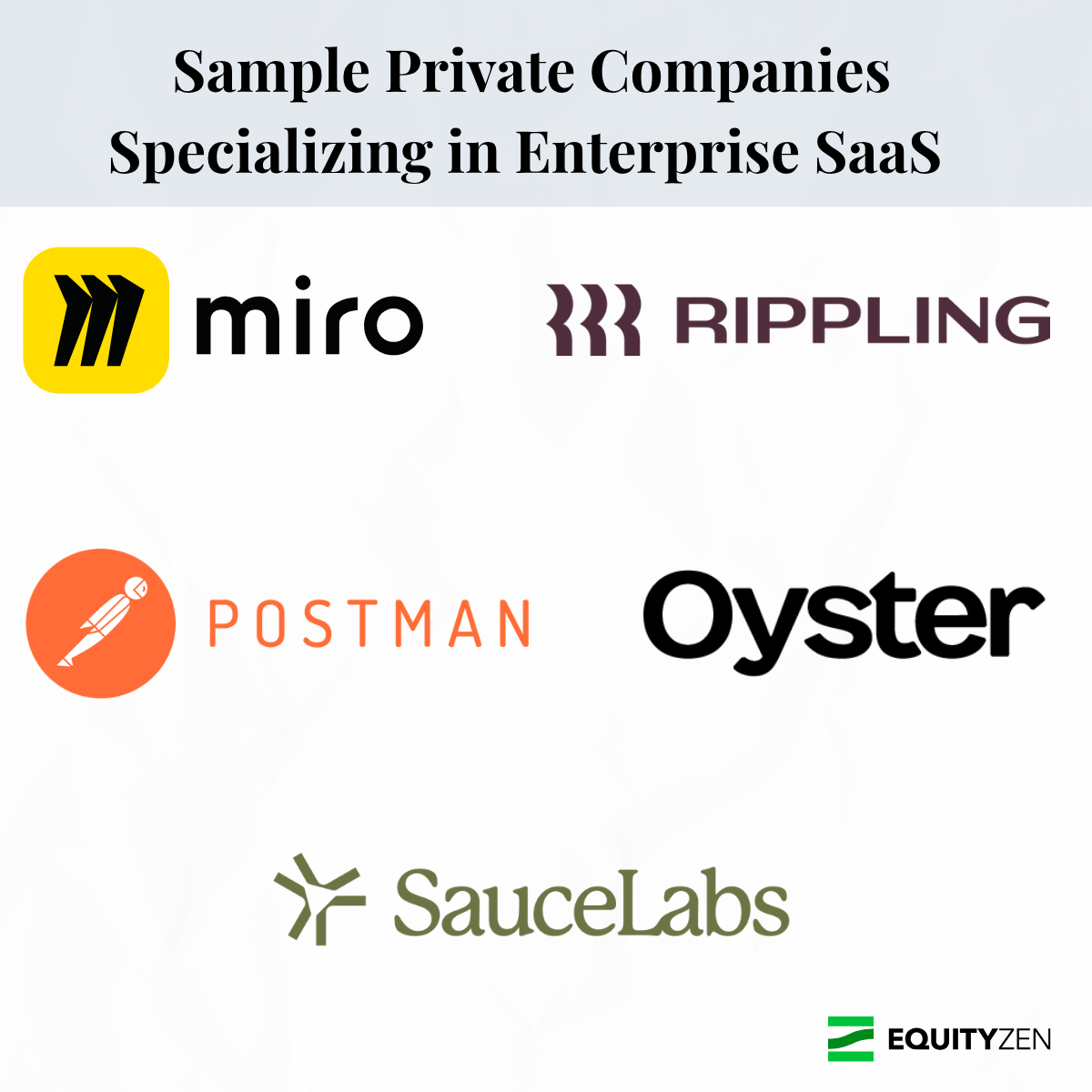
There are numerous private companies that provide Enterprise SaaS solutions across various subsectors. Here is a sampling of leading companies in the space, by segment.
Remote work and collaboration:
- Miro: Miro offers a collaborative whiteboard platform that is designed to allow distributed teams to work together. Support includes running brainstorming sessions and workshops as well as planning projects and designing new products and services, with integrations available for applications like Atlassian Jira and Confluence, Sketch, Slack, Trello, Box, and Google Drive. The company has more than 100 million users across 250,000 organizations.10
- Oyster HR: Oyster HR offers a global employment platform specifically designed for compliant onboarding, payroll, and benefits for remote-first teams operating globally, with availability spanning more than 180 countries.11
- Rippling: Rippling combines HR, IT, and finance under one platform so companies can run everything from global payroll to app provisioning without juggling dozens of disconnected tools. When a new hire starts, Rippling handles their onboarding, sends out their laptop, sets up their software access, and adds them to payroll—all in a few clicks. Rippling also features more than 600+ out-of-the-box integrations. These integrations include everyday tools like Slack, Google Workspace, and Zoom to keep daily operations running smoothly.12
Developer tools and cloud infrastructure:
- Postman: Postman is an API development environment, used by more than 40 million developers and more than 500,000 organizations worldwide, including 98% of Fortune 500 companies.13
- Sauce Labs: Sauce Labs provides cloud-based testing for mobile and web applications. In early 2026, it expanded into autonomous testing with Sauce AI, a suite of intelligent agents that automates software testing, debugging, and quality analysis.14
Looking forward
With a sizable market opportunity and an increasing focus on workflow automation, Enterprise SaaS remains poised for continued growth. Its core fundamentals—high customer lifetime value, low incremental distribution costs, scalable architecture, and predictable recurring revenue—continue to attract innovators.
However, navigating today’s landscape requires managing real risks, including market consolidation and heightened scrutiny on buyer ROI. AI also poses a threat to traditional per-seat pricing models. As software automates more tasks, traditional per-seat expansion is likely to reach a ceiling. Meanwhile, variable billing introduces buyer friction around budget predictability, and operating as core infrastructure raises the bar for security and regulatory compliance.
Adapting to these operational realities will help define which providers win the next era of enterprise growth. And for investors, these headwinds may create compelling entry points into category-defining software companies.
Visit the EquityZen listings page to explore private companies driving the next generation of enterprise productivity.
Join Investors and Shareholders Exploring the Private Markets Today





.svg)