
In this article
Key points
- Structural private-market constraints typically prevent secondary liquidity from keeping pace with secondary demand.
- All of EquityZen’s completed Q2 deals involving companies under 6 years old were AI startups,1 suggesting the sector is beginning to emerge as a liquidity outlier, albeit on a small sample size..
- Nearly half of all AI-related IOIs submitted on EquityZen in Q2 targeted companies under six years old,2 pointing to balanced investor appetite across both early-stage and mid-late-stage AI startups.
The AI effect
For over half a century, private companies followed the same playbook: lock up your equity until an IPO or M&A exit. And at a time when companies could expect to go public within four to six years,3 that convention made perfect sense. But today—with the average time to IPO stretching to 16 years4—waiting for a terminal exit is no longer viable for many founders and early employees. The rise of AI has brought this new reality into even sharper focus, with some startups deploying tender offers and secondary sales within just a few years of launching.
These developments raise a fundamental question for investors: are traditional private-company liquidity timelines gone for good, or is this activity a temporary phenomenon driven by AI market trends?
First principles: demand vs. liquidity
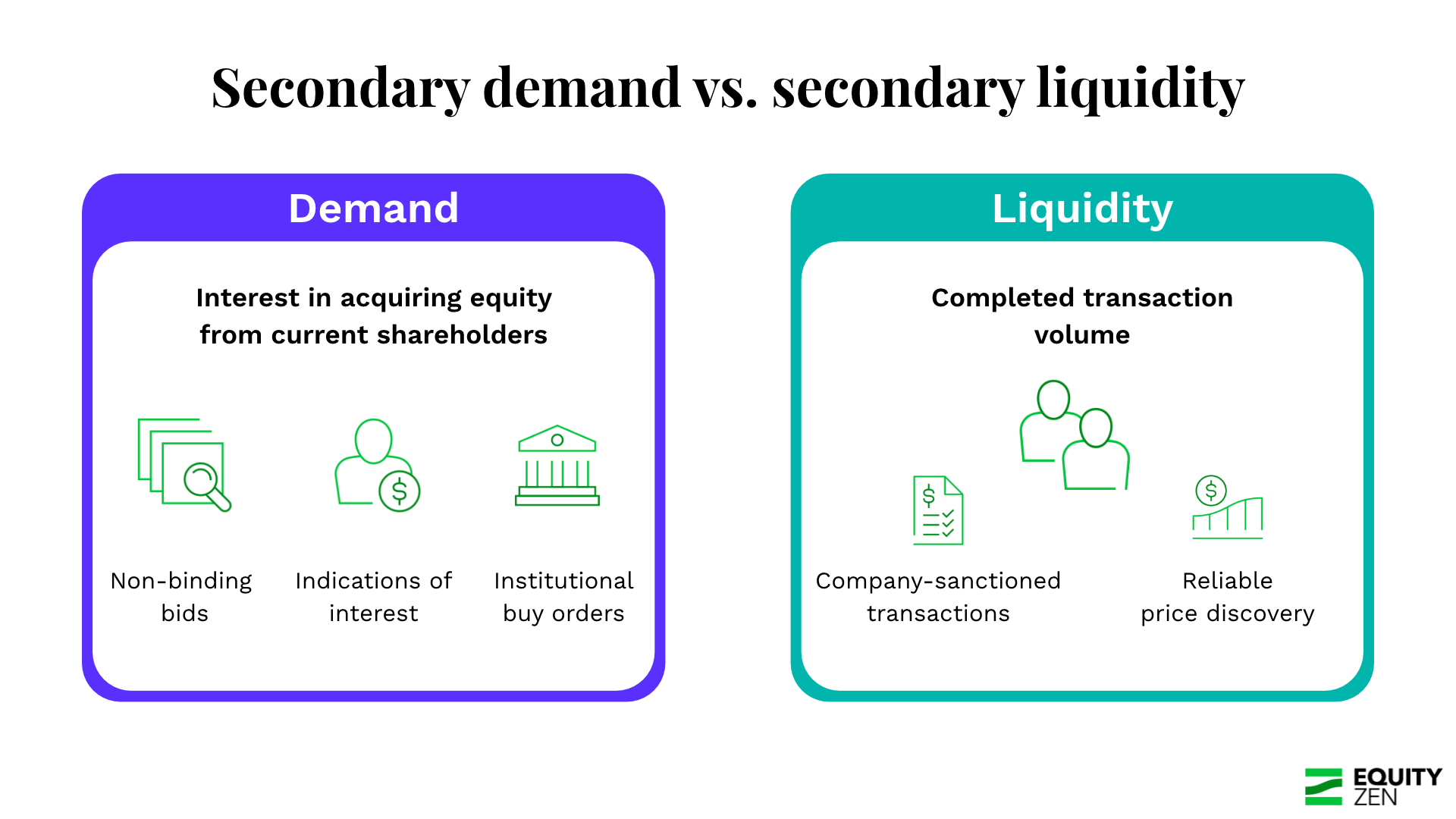
To evaluate whether liquidity timelines are truly shifting, we must first separate secondary demand from secondary liquidity—a distinction that often gets blurred.
Secondary demand means there is active buying interest in a private company or fund’s pre-existing shares, units, or fund commitments on the secondary market. It is typically quantified through non-binding bids, indications of interest (IOIs), or buy orders. Secondary liquidity, on the other hand, means that private company shareholders can sell a portion of their shares to one or more investors.
In other words, while demand means there is investor interest, liquidity means actual trading is possible. But importantly, even on secondary trading platforms like EquityZen, companies retain transaction oversight through Rights of First Refusal (ROFRs).
The fluctuating dynamics between demand and liquidity underscore EquityZen’s role in helping investors navigate the secondary market. By tracking both executed transactions and unmet demand, , it has the potential to paint a fuller picture of a private company’s market profile at any given time.
Industry tailwinds
Several AI startups—like ElevenLabs, Harvey, and Perplexity, all founded in 2022—have generated secondary pricing, investor interest, and tender offers well before any clear IPO timeline. These developments suggest that the AI sector is testing traditional liquidity timeline assumptions.
However, several conditions unique to the current AI cycle—which may prove temporary—are likely driving this activity. Rapid valuation growth has created massive paper wealth earlier in many companies’ lifecycles, while the AI talent war has turned early, structured liquidity into a valuable recruiting and retention tool. Accelerating commercial adoption also means that some AI companies are achieving a level of public visibility typically reserved for much older consumer or enterprise brands—such as Harvey, which launched a high-profile US Open sponsorship in 2026.5
But as previously discussed, secondary demand is not synonymous with secondary liquidity. While these AI standouts appear to demonstrate high visibility, brand presence, and market demand, they do not prove that private liquidity timelines are fundamentally changing across the industry, let alone the broader private market.
Why liquidity lags demand
While secondary demand for shares in top AI startups can spike rapidly, it does not instantly convert into executable liquidity–a dynamic recently highlighted by J.P. Morgan in its analysis of the secondary market.6
Several core operating principles of the startup world help explain this gap, including:
- Longer time horizon expectations: Regardless of how quickly a company scales and attracts investor interest, expected liquidity time horizons are still longer for private companies. Early investors generally come in with the expectation that they’ll hold their stock through multiple stages of company growth—and if the business is performing well, they’re likely to have even less incentive to sell.
- A limited seller pool: Young companies naturally have fewer vested employee shares and former employees, which means fewer shareholders are seeking to rebalance at any given time. So even in the face of significant buyer demand, a company’s potential seller base may be relatively small.
- A preference for controlled liquidity: Creating repeatable shareholder-liquidity processes or building an internal team capable of administering them is unlikely to be an early operational priority for startups. At the early stages, companies typically want more control over their cap tables to avoid public reporting requirements, protect their operational flexibility, and preserve control over major corporate decisions. This creates a timing mismatch, where investor appetite might accelerate faster than the infrastructure required to support company-approved transactions.
To bridge this gap, companies may rely on employee tender offers and secondary trading platforms like EquityZen. These mechanisms offer selective shareholder liquidity without making shares broadly or consistently available. EquityZen, for example, utilizes pre-IPO special purpose vehicles (SPVs) to pool capital from multiple accredited investors into a single dedicated fund, rather than matching one seller to one buyer. This structure lowers investment minimums, helping expand market access and participation.
What EquityZen data shows
Recent activity on EquityZen’s platform provides compelling insights into whether AI may be reshaping private-market liquidity norms.
Overall, secondary deal volume in Q2 2026 remained strongly concentrated in mature companies (6+ years old) across completed deals (98.02%).7 But interestingly, all of the deals involving companies under 6 years old were AI startups,8 suggesting the sector is beginning to emerge as a liquidity outlier, albeit on a small sample size.
The demand side of the market helps complete the picture. AI companies generated strong interest in Q2 2026, receiving nearly half (49.61%) of all submitted IOIs.9 Of those targets, 48% were less than 6 years old.10 Beyond highlighting the appeal of AI startups in Q2, this data points to a balanced appetite among secondary investors across both young and more mature AI companies.
Taken together, these metrics appear to reveal a dynamic secondary market operating on two distinct tracks. On the supply side, liquidity remains almost exclusively reserved for mature, proven assets—with AI standing out as the sole exception capable of cracking open early-stage dealflow. On the demand side, however, investor interest tells a more nuanced story: while buyers still direct most of their intent toward more mature companies, nearly half are actively seeking exposure to younger AI targets.
This divergence suggests that actual closed transactions involving AI companies have not yet caught up with buy-side appetite. The key question ahead is whether pent-up demand will continue and eventually translate into higher transaction volume.
Connecting the dots
In summary, structural private-market constraints—including longer investment horizons, limited seller supply, and tight corporate transfer controls—typically prevent secondary liquidity from keeping pace with investor demand. AI startups, however, are beginning to narrow that gap, based on recent EquityZen platform activity. While realized secondary liquidity has not yet matched AI investor demand, AI companies appear to be defying broader market trends by representing an outsized portion of Q2 secondary deals among companies under 6 years old. Time will tell whether rapid valuation growth, the AI talent war, and accelerated commercial adoption are driving a temporary surge, or if AI is permanently rewriting the secondary liquidity timeline. Either way, there are indicators that AI is moving at a pace all its own.
FAQs
1) What is private-market liquidity?
Private-market liquidity is the ability for shareholders in private companies—such as founders, early employees, and early-stage investors—to sell their stock for cash before the company undergoes a major liquidity event, like an IPO or an acquisition. Unlike the public market, where shares can be traded freely on exchanges like NASDAQ or NYSE, private equity is inherently illiquid. Private-market liquidity mechanisms, such as tender offers and secondary trading platforms like EquityZen, provide a compliant way for shareholders to potentially realize gains without waiting for the company to go public.
2) How do investors buy shares in a private AI company?
Investing in pre-IPO AI companies is generally limited to accredited and institutional investors through primary fundraising rounds, in which they’re allowed to purchase newly issued preferred stock from the company, or through secondary market purchases, where they buy existing shares directly from current shareholders using platforms like EquityZen or specialized brokers.
3) Why are some AI companies generating secondary-market interest so early?
The surge in early secondary demand for some private AI companies appears to stem from several sector-specific market conditions, including high pre-IPO valuations, intense talent competition, and accelerating commercial adoption and name recognition. AI development also requires vast capital upfront for computer hardware and infrastructure, prompting fundraising rounds that draw interest earlier in a company’s lifecycle.
4) What are some of the risks of investing in an early-stage AI company?
While early-stage AI investments offer high upside potential, they carry structural risks. These include heavy capital demands that raise dilution risk (that is, a reduction in the ownership percentage of existing shareholders), rapid technological shifts that threaten competitive moats, and fast-changing regulatory and IP requirements. Like all private companies, early-stage AI startups also offer limited liquidity and financial transparency compared to public companies.
5) Does strong investor demand mean a company’s shares are liquid?
No. Demand and liquidity are not synonymous. While strong demand may drive up implied valuations, selling private shares remains a complex process controlled primarily by the company. True secondary liquidity requires company-sanctioned transaction volume that enables reliable price discovery.
Join Investors and Shareholders Exploring the Private Markets Today