
.png?width=96&height=96&name=image%20(5).png)
.jpg?width=1318&height=736&name=shutterstock_775976068%20(1).jpg)
In this article
Key points
- Private market technology is removing friction around access, liquidity, transparency, and operational efficiency to make the pre-IPO investing experience more like public company investing.
- The U.S. accredited investor pool is growing, and companies are reaching higher valuations before going public.
- The next challenge will be deploying technology in ways that better align the public and private market investing experiences while maintaining the unique structure of private assets.
Where we are
Sixteen years. That’s how long the average company waits to go public.1 And with private fund net asset values surging past $16 trillion,2 many of the best investment opportunities are happening long before an IPO. Historically, high investment minimums have kept all but a few on the sidelines—a dynamic that is clearly no longer viable in the shifting market. So where does that leave today’s investors?
Fortunately, technology is now breaking down long-standing barriers to entry by removing friction around access, liquidity, and transparency. The next challenge will be deploying new digital tools and capabilities in a way that creates a more integrated market while still preserving the unique structure of private assets. If balanced successfully, the result will be a healthier, more robust financial environment that bridges the public and private markets without breaking down their needed structural boundaries.
The old private market model
Traditionally, private company investing has been defined by constraints absent in the public market. Access was effectively locked behind an institutional wall, with private assets primarily reserved for VC funds and ultra-high-net-worth buyers. On the shareholder side, a lack of centralized exchanges and strict internal company controls starved early employees and investors of liquidity. Finally, private market investing suffered from heavy operational drag. Manual eligibility checks, tedious documentation, and slow board approval cycles created a bottleneck that for many was simply too cumbersome.
Taken together, these friction points created a psychological wall. For most investors, pre-IPO investing felt like a separate and far more intimidating world than public equities—one that was best left for the uber-wealthy and uber-connected.
But times are changing.
-png.png?width=1200&height=1200&name=Fragmentation%20(2)-png.png)
Shifting conditions
In recent years, the right elements have fallen into place for a private market shake-up. The accredited investor pool has significantly expanded—jumping from just 3% of U.S. households in 1989 to roughly 18.5% in 2022, according to SEC data.3 At the same time, many companies are staying private longer and capturing more value before even considering an IPO. In fact, S&P Capital IQ data shows private companies today make up more than 86% of U.S. companies with more than $100M in revenue.4
All these changes add up to an enormous concentration of enterprise value locked inside private markets, at the same moment when millions of new investors are qualified to participate.
Enter technology.
Broadening the doors
With macro forces aligned, technology is now dismantling the practical distinctions that have long set the private market apart, beginning with access.
Digital secondary marketplaces like EquityZen are at the forefront of this movement. By leveraging fractionalized special purpose vehicles (SPVs), these private investment platforms can break multimillion-dollar minimum allocations into smaller blocks of shares. As a result, participation is now possible at a significantly lower minimum, helping improve investor access.
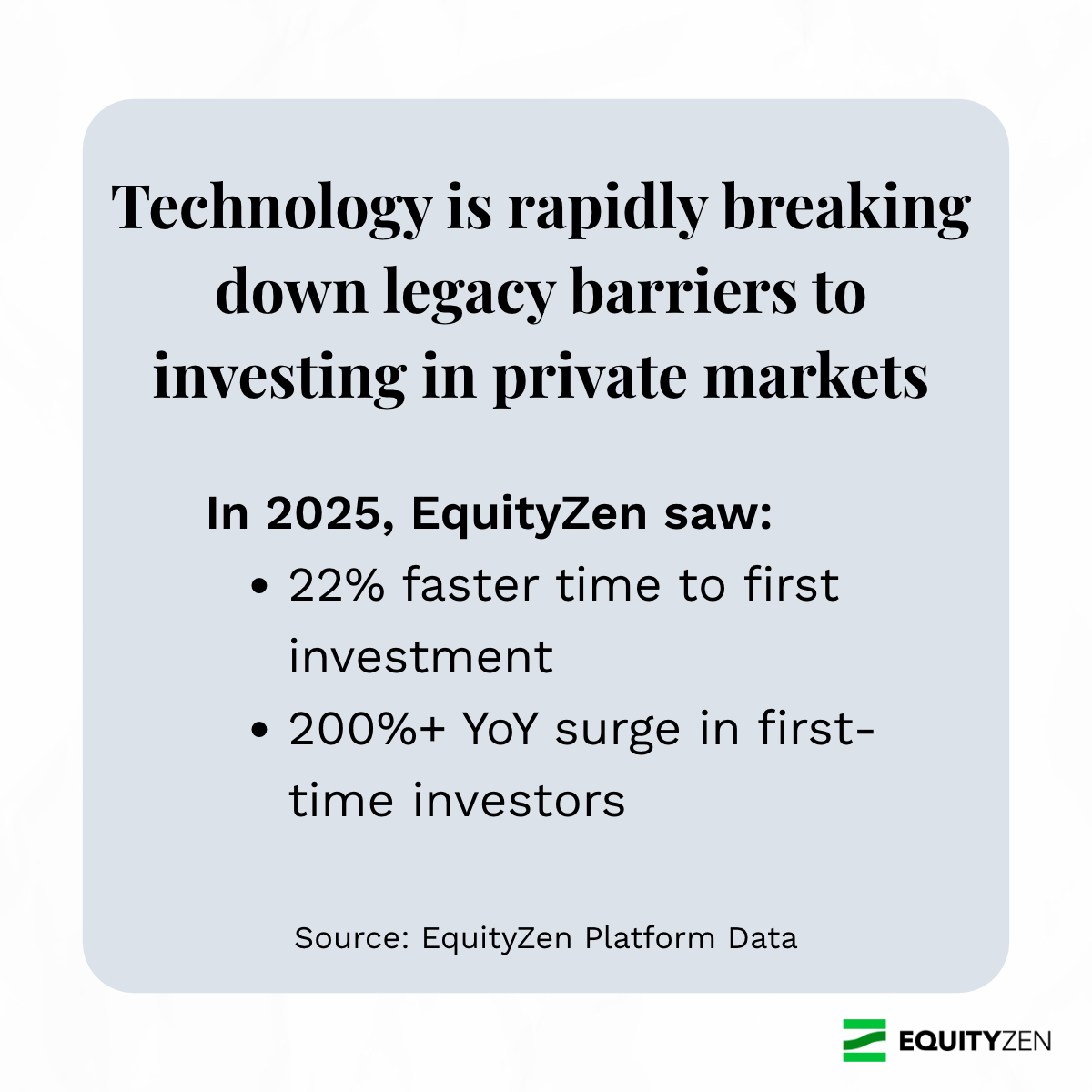
In 2025, platform data from EquityZen revealed a 22% faster time to first investment and a 200%+ year-over-year surge in first-time investors5—demonstrating that technology can rapidly break down legacy barriers.
Ending the waiting game
Beyond investor access, technology is also tackling another friction point in the private market: illiquidity.
Historically, selling private company shares required finding a direct buyer or waiting years for an M&A exit or IPO. Standard fund structures exacerbated the problem by imposing rigid Limited Partner Agreement (LPA) transfer restrictions and lockups, leaving early shareholders and investors trapped.
But now, technology is unlocking liquidity by digitizing assets and connecting the pools of supply and demand. For example, digital investment platforms like EquityZen are matching shareholders with accredited buyers directly and are using SPVs to bypass high minimum purchase thresholds, helping expedite transactions. In some instances, investors can also resell their interest in a single-company fund through Express Deals6 on EquityZen.* Because Express Deals are simple transfers of existing fund interest, they bypass Right of First Refusal (ROFR) requirements and can close in as little as three days. Developments like these have helped turn a years-long waiting game into a much more efficient market for all parties.
Lifting the curtain
Transparency is woven into the very fabric of the public market—with real-time quotes, analyst reports, and standardized filings all at one’s fingertips. The private market, by contrast, has long operated behind a veil. Determining fair market value was particularly difficult, bogged down by sparse disclosures, a lack of central exchanges, and lagging Net Asset Value (NAV) reporting.
But technology is now lifting the curtain on this once opaque market. Cloud platforms have emerged to provide estimations of asset valuations and cashflows, allowing investors to stream fund data directly into their own internal and portfolio management systems. EquityZen users, for example, have access to a proprietary Equity Value Calculator7 and Market Score metric,8 allowing them to estimate the current value of private company shares and research pre-IPO companies using platform data. Investors can also leverage on-demand portals, like EquityZen’s Investor Dashboard, for 24/7 visibility into distributions and other company updates. At the same time, due diligence is further being enhanced by automated document processing tools, cloud services, machine learning and other technologies. For example, EquityZen uses proprietary technology to verify assets, model cap tables, and perform other deal-level due diligence—although importantly, these checks are not a replacement for independent investor due diligence.
Advancements in technology are also driving the increased integration of private asset benchmarks on financial networks—a shift that is helping broaden market intelligence. EquityZen’s partnership with Yahoo Finance illustrates this move toward expanded information access.9 Investors can now readily explore companies, developments, and trends on Yahoo Finance to make more informed private investment decisions, referencing proprietary EquityZen data and private market insights that have been made available.
Unlocking the gears
Until recently, private market infrastructure has lagged far behind that of the public market. But technological advancements are now directly addressing operational bottlenecks for an improved investor and seller experience.
Notably, by leveraging a suite of digital tools, private investment platforms are able to support efficient order matching and deal execution. For example, platforms can use historical deal data to develop algorithms that match buyers and sellers faster. Automated document reviews, digital e-signatures, and cloud-hosted cap tables are also eliminating tedious manual overhead.
These upgrades have resulted in a recalibration of the entire private market ecosystem. Pre-IPO investing can now occur with speed and ease—utilizing an infrastructure that increasingly mirrors the efficiency of public markets.
The next horizon
Despite sweeping technological advancements that have improved market access, transparency, and functionality, private market investing remains a fragmented experience. Deals still require separate platforms and specialized relationship networks outside of traditional exchanges. And rather than relying on single-click execution, the process continues to involve multiple steps and intermediaries from start to finish. In particular, ROFRs create significant friction, as they permit an issuer to take up to 30 days to approve a transaction.
Not only does this fragmentation extend timelines, but it also contributes to a psychological divide that can dissuade many qualified investors despite the potential upside. In fact, SEC data shows that only 4.3% of qualified accredited investors report owning or investing in private market securities.10
The next horizon will be leveraging technology to create centralized access points that create a more unified market across public and private assets. At the same time, it is vital to remember why certain parameters exist in the first place. By design, the private market is an inherently riskier environment for investors—featuring longer time horizons, multitiered equity classes, infrequent funding rounds, and limited public reporting requirements to insulate companies from short-term pressures. As technology continues to evolve, the goal will be introducing new tools and capabilities that reduce unnecessary complexity while preserving the needed safeguards for responsible participation.
FAQs
1) Do you need to be an accredited investor to invest in private companies?
In most traditional private secondary transactions, yes. Under current U.S. securities regulations, participation in private fund structures or direct pre-IPO secondary offerings is generally restricted to accredited investors. However, non-accredited investors can gain exposure to early-stage private companies through Regulation Crowdfunding (Reg CF) offerings on dedicated platforms.
2) How can individual investors access private companies?
Individual investors can access private companies through online secondary marketplaces like EquityZen that fractionalize access via Special Purpose Vehicles (SPVs). Additionally, investors can participate via venture capital funds, private equity funds, or equity crowdfunding platforms for early-stage startups.
3) How does technology help match buyers and sellers of private company shares?
Modern technology uses algorithmic matching engines to analyze bid-ask spreads, order sizes, and historical deal data across prospective buyers and sellers. Automated compliance checks, cloud-hosted cap table management, and electronic signatures further accelerate buyer-seller discovery.
4) Will private investments become more accessible to individual investors?
The trend points toward increasing access. As digital secondary platforms lower minimum investment thresholds (often from millions down to a few thousand dollars), more individual investors are gaining structured exposure to private assets.
5) Can you invest in private companies through a brokerage account?
Generally, standard retail brokerage accounts only support publicly traded securities. However, some traditional brokerages are beginning to partner with private market platforms or offer interval funds and specialized private equity vehicles directly through wealth management accounts for qualified clients.
Join Investors and Shareholders Exploring the Private Markets Today





.svg)