
In this article
Key points
- With IPOs slowing in Q3, investors actively deployed capital into the private secondary market, as demonstrated by an increase in transaction check size and volume.
- Deal activity concentrated heavily on mid-late-stage companies (valued at $5B–$10B) and investments in the AI, FinTech, and Emerging Energy sectors.
- Investors appear to be shifting away from speculative AI valuations toward disciplined pricing and strict quality standards, seemingly encouraging sellers to accept lower prices and markdowns.
- In contrast, 60% of Enterprise SaaS trades executed at a premium, revealing a mark-up for top category leaders despite low overall deal volume in this sector.
A maturing market
Marked by higher transaction volumes and sizes, the third quarter of 2026 reinforced that the private secondary market has become an established way of buying and selling assets, rather than an experimental tool. This momentum unfolded alongside unprecedented fundraising, with Crunchbase reporting an all-time record of 27 companies raising billion-dollar-plus rounds—an increase from last quarter’s previous record of 16 companies.1 Together with an increase in the number of unicorns and delayed IPOs, these market conditions created a strong foundation for private-company liquidity.
Increasing liquidity
Unlike Q2’s wave of public debuts, top-tier private companies pivoted to massive growth rounds in Q3—led by $5 billion raises from Databricks2 and Safe Superintelligence.3
Against this backdrop, the secondary market served as a resource for private-company shareholders seeking liquidity in Q3. Trading activity increased on EquityZen, which recorded a +57.4% quarter-over-quarter increase in transaction volume (based on combined buy and sell volume) and continued a steady trend of year-over-year growth.
Transaction sizes grew alongside the increase in volume. Average buy-side transactions grew 38% from the previous quarter, while sell-side transactions rose +103.96%.
Market polarization
AI continued to drive activity in Q3, accounting for 43% of deals. FinTech followed, comprising 24.1% of deals. Together, these two sectors captured more than two-thirds of all deals, demonstrating concentration in secondary private liquidity.
Emerging Energy ranked as the third most active sector, driven by demand for the physical power infrastructure required to support AI growth. Its emergence as a sector of interest over established categories like Enterprise SaaS and Traditional Tech could mark a key inflection point. Capital-intensive energy and hardware companies—which historically faced longer liquidity horizons—have reached the scale and valuation maturity needed to trigger steady trading.
Market polarization could also be seen in the concentration of deals at specific valuation tiers. Overall, 80% of all Q3 deals involved mid-late-stage companies (valued at $5B–$10B) and mega-cap companies (valued more than $20B). The apparent sweet spot for deal activity was the $5B–$10B valuation range, which comprised 63.6% of total deal volume. In contrast, earlier-stage startups (<$5B) accounted for 12.7% of deals and mid-tier mega-caps ($10B–$20B) accounted for merely 7.3%. These figures appear to demonstrate that investors prioritized mid- and late-stage startups over early-stage speculation. They also largely bypassed the $10B–$20B tier, where valuation expectations from prior peak bull cycles created friction.
A disciplined pricing climate
Discount frequency widened further in Q3, with 83.54% of all platform trades executing below prior primary valuations (up from 74.7% in Q2). This valuation reset was particularly sharp in AI, where the share of premium transactions decreased to 26.47%, down from 62.0% in Q2. Meanwhile, legacy sectors—including FinTech, Healthcare, Consumer/Lifestyle Tech, and Traditional Tech—saw 100% of transactions close at a discount. Enterprise SaaS emerged as an exception to this trend. Although overall SaaS deal volume was low, 60% of trades executed at a premium, revealing a mark-up for top category leaders.
Taken together, these developments suggest that investors are no longer willing to pay speculative premiums for AI companies. Instead, investors are applying greater price discipline and are setting a higher bar for quality. As public debuts remain slow and discounted secondary pricing becomes standard, sellers appear increasingly inclined to accept markdowns relative to prior paper valuations.
Companies on the rise
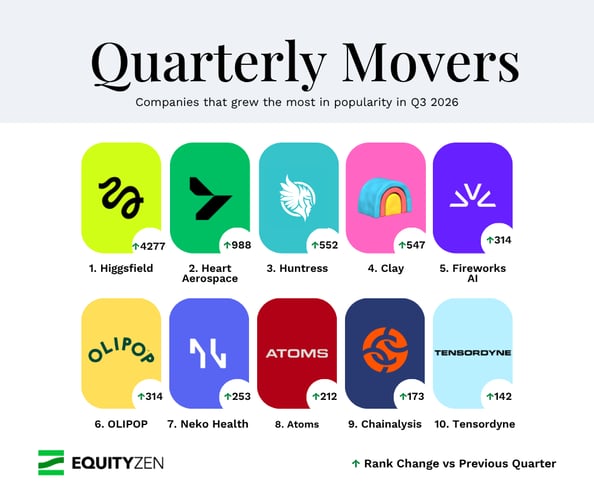
EquityZen’s “Quarterly Movers” list tracks the private companies that experienced the largest increases in investor popularity quarter-over-quarter, based on the total increase in indications of interest (IOIs) and page views on EquityZen’s platform. In Q3 2026, investor interest shifted significantly—with Generative AI and AI Infrastructure replacing CleanTech and Energy Infrastructure as the leading categories. This movement was anchored by Higgsfield, a video AI firm, which took the #1 spot with a dramatic +4,277 rank jump. It was joined by Clay (+547), an AI-driven go-to-market (GTM) and data operations startup; Fireworks AI (+314), an AI infrastructure company; and Tensordyne (+142), an AI inference platform.
Other top performers included electric aircraft manufacturer Heart Aerospace (+988, taking the #2 spot) and industrial AI robotics platform Atoms (+212). Their rise in popularity appears to reflect broader momentum across hard-tech, transport, and physical automation companies as they work to reach the scale and maturity needed to generate active secondary liquidity.
Although traditional Enterprise SaaS saw low overall deal counts in Q3, cybersecurity firm Huntress (+552) and blockchain intelligence provider Chainalysis (+173) increased in popularity, demonstrating demand for mission-critical software. Prebiotic beverage maker OLIPOP (+314) and preventative health scanner Neko Health (+253) rounded out the list—showing that consumer tech trading remains anchored by recognizable category leaders in health and wellness.
Many of the companies appearing on the list also completed major financings in Q3, including Higgsfield, Clay, Fireworks AI, Neko Health, and Atoms–helping drive their rise in popularity.
Looking ahead
As Q3 transaction activity approached platform peaks, private secondary trading appears to be solidifying its role as a reliable liquidity option. At the same time, investors are demonstrating heightened price discipline. Activity on the EquityZen platform appears to show significant polarization, with deal activity concentrating on mid-late-stage companies (valued at $5B–$10B) and investments in the AI, FinTech, and Emerging Energy sectors. As we enter the final quarter of 2026, it will be telling to see whether investors continue prioritizing proven late-stage leaders in a climate that is scrutinizing tech returns.
Join Investors and Shareholders Exploring the Private Markets Today